
Tampa Previous Resident Sources
A backward address trail needs both ownership and occupancy evidence. Hillsborough recorded books reach beyond the web index, HCPLC holds directory and newspaper resources, and modern parcel and permit files identify the structure. Coverage differs by series, so gaps should remain visible.
| Source | Local years | Keeper | Contribution |
|---|---|---|---|
| Online Official Records | 1965 to present | Hillsborough Clerk | Deeds, liens, plats, parties |
| Recorded books | 1836 to 1964 | Official Records Library | Pre-digital ownership chain |
| Tax rolls | 1883 to present | Clerk and HCPA archives | Assessed owner and value |
| City and reverse directories | Scattered late 1800s through 1900s | HCPLC | Occupant by edition |
| Federal census | Released through 1950 | NARA and libraries | Household members |
| Permits | Digital years vary | Tampa or Hillsborough | Construction dates |
The Clerk's records page explains the online and library split.
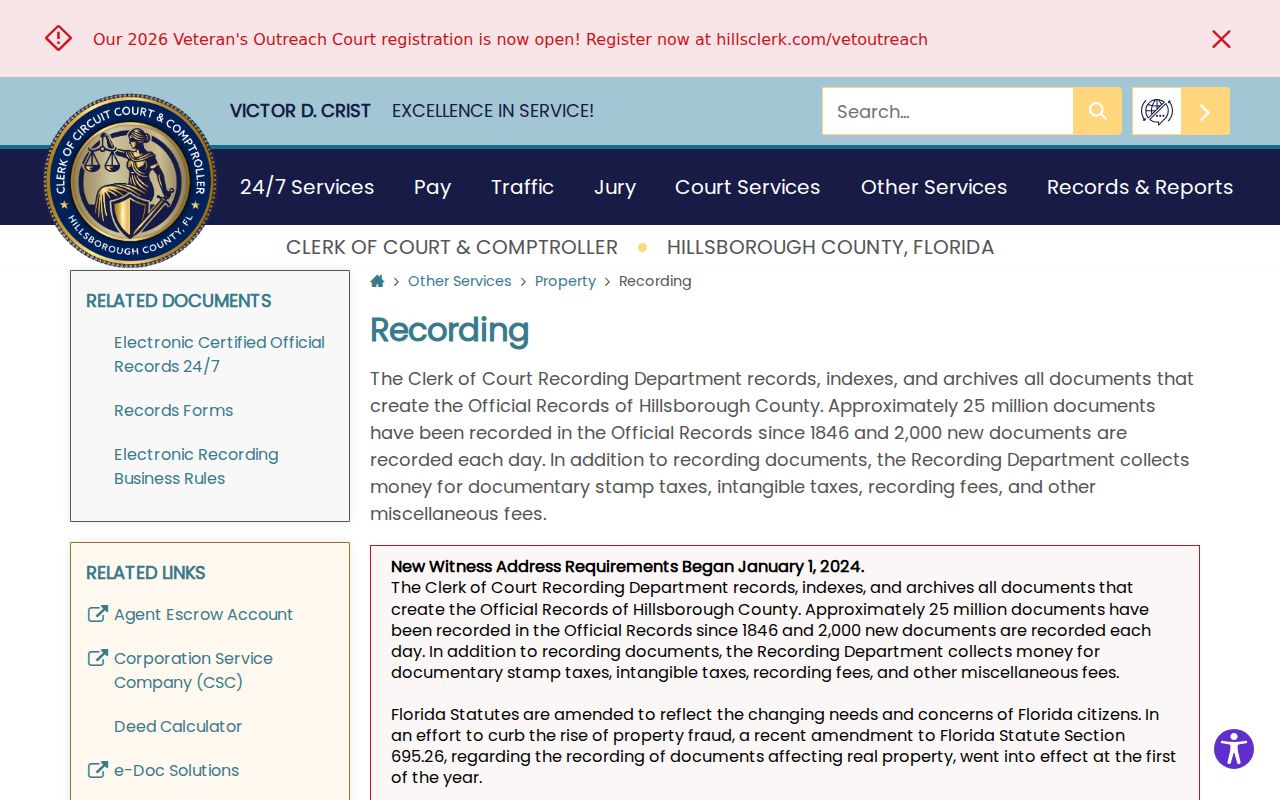
Recent instruments start online. Older work continues through books, microfilm, and archived indexes.
The Clerk also identifies marriage licenses from 1831 and tax rolls from 1883. Those records do not replace deeds or resident directories, but they can connect spouses and place an assessed owner in a dated local series. Newspaper coverage across the Tampa Tribune, Tampa Bay Times, Florida Sentinel Bulletin, and La Gaceta can fill moves, deaths, sales, and community events that terse government indexes omit.
Walk Tampa's Deed Chain Backward
Start with the HCPA parcel card, not a street search in the deed index. Save the folio, legal description, current owner, sale reference, municipality, and situs address. Open the acquisition deed, confirm the parcel, and identify the seller. Hillsborough calls the conveying owner the direct party and the acquiring owner the reverse party.
- Search the present owner as reverse party and open the acquisition deed.
- Read the grantor, date, legal description, and prior reference.
- Search that grantor as reverse party in an earlier date range.
- Repeat only after the legal description confirms the land.
- At 1965, continue through the Official Records Library or Kofile books.
- Grantor / grantee
- The party conveying property and the party receiving it.
- Chain of title
- The linked sequence of transfers for one parcel.
- Legal description
- The lot, block, subdivision, or metes-and-bounds land identity.
The Hillsborough Kofile portal bridges older deed series.
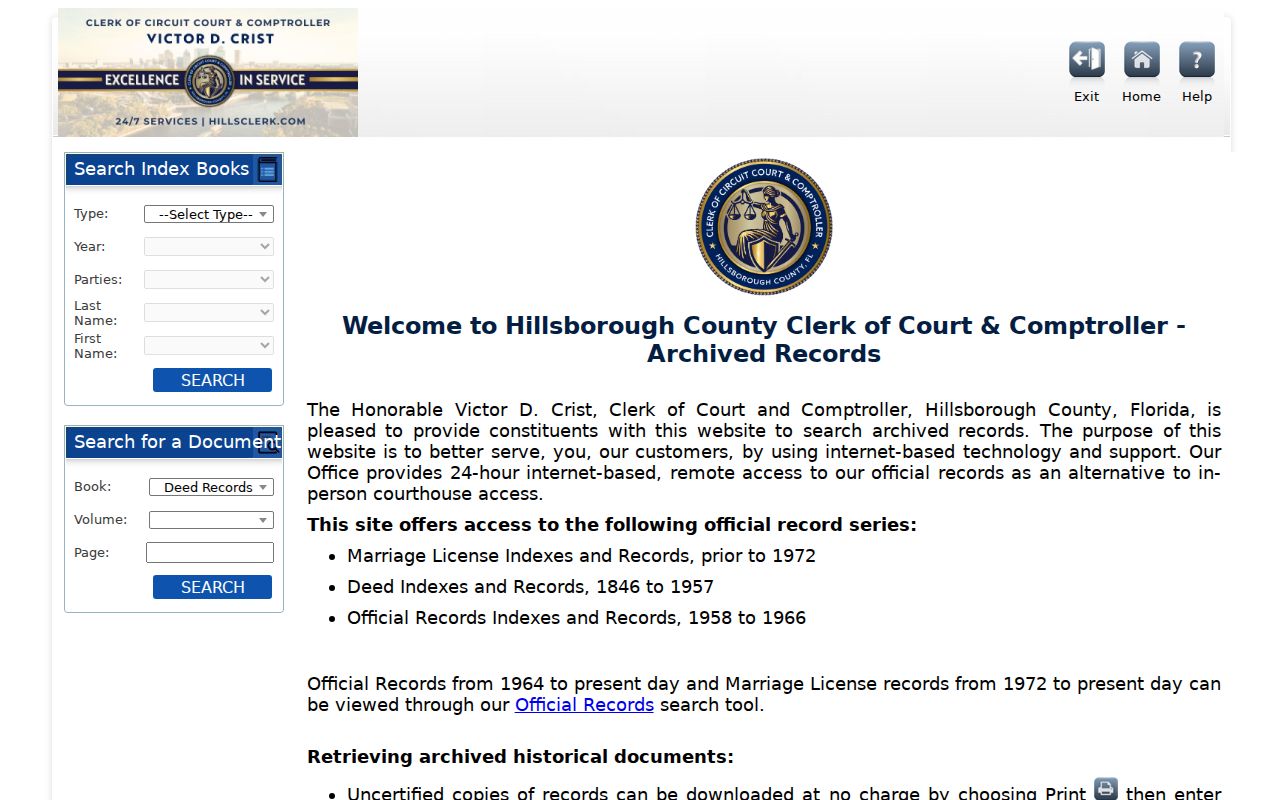
Its party, book, volume, and page controls keep the same parcel trail moving past the web cutoff.
A quitclaim or intra-family deed is not always a market sale. Read the instrument type, consideration, related references, and full legal description before treating it as a household move. Recorded return-to and prepared-by addresses can be useful leads, but neither one proves residence. Restricted document classes may be visible only at a courthouse workstation or through authorized access, so the public web image set is not the whole library.
Tampa Past Residents Beyond Owners
A deed chain names owners, not all previous residents. Compare each ownership period with reverse directories, released census schedules, permits, obituaries, and probate. Matching mailing and situs addresses plus homestead can support owner occupancy, but does not list every household member. The collections appear in the Tampa city directory.
Use this flow: deed period → directory edition → nearest released census → newspaper or obituary → probate. Keep each date beside each name. Directory gaps and moves can otherwise make one person appear to be two.
Search Tampa names with care. Spanish double surnames, married and maiden forms, initials, suffixes, anglicized spellings, and dropped diacritics are common in local sources. An occupation, spouse, or exact street can separate two people who share a name. Reverse directories help when the address is known, while name-first editions work better after a deed supplies the owner.
Lawful use. Tampa previous-resident research fits house history, genealogy, and estate work. Never use an address trail to harass, watch, or harm a living person.
Date Tampa Previous Residences
Sanborn maps show building footprints, uses, and street labels for selected years. They can reveal whether today's structure existed or whether an address meant another building. Tampa Accela adds building, planning, and code records. Older files may require a request.
The Tampa Sanborn collection supplies map editions.
Compare the index, street name, and block shape before matching a historic number to the modern parcel.
Tampa Address Changes Break Trails
Lafayette Street became Kennedy Boulevard, and Michigan Avenue became Columbus Drive. An official HABS example documents 2410 Twelfth becoming 2506 N. 12th. No official single citywide renumbering year was found. Resolve each mismatch with plats, directory guides, Sanborn indexes, and deeds.
Early Hillsborough covered a much larger region, while postal Tampa still extends outside city limits. The legal description is stable when the street label fails. The State Archives of Florida offers research services.
Archive staff can identify series and maps when a vanished street or boundary stops the trail.
Hillsborough was organized in 1834 and once covered land later divided among many counties. The first courthouse burned in 1836, and court books were moved for safekeeping during the Civil War. These facts make series-by-series survival checks essential for the earliest Tampa previous residents. A modern county boundary should never be projected backward without checking the date.
Tampa Obituaries Close the Trail
When a deed passes through an estate, search probate and newspapers for the deceased owner. HCPLC will search up to three obituaries free and states a reply within fourteen days. Historic tax records add another dated address point.
The Hillsborough tax records search is an official route.
A tax entry supports ownership or business activity at one point. Pair it with a directory or census before calling someone an occupant.
Cemetery and burial records can add a final Tampa location, while probate dockets can identify an estate, personal representative, heirs, and filings tied to the transfer. A docket is the court's event list, not the full evidence in every filing. Search the named decedent and representative, check dates against the deed, and request the public case document when the index alone cannot explain the conveyance. Sealed, adoption, juvenile, and other confidential material remains unavailable.
HCPLC newspaper coverage is not one continuous title. The Tampa Tribune, Tampa Bay Times, Florida Sentinel Bulletin, and La Gaceta serve different communities and years. Search name variants, an old address, a spouse, and a narrow date range. A social notice or obituary can document a move or family link, but it should be paired with a directory edition, census schedule, deed, or vital record before it becomes part of the address timeline.
Access Tampa Address History
Modern parcel cards and public deeds are free online. When an image is restricted or the year predates the public portal, use the Clerk's Official Records Library, public workstations, telephone, email, or a copy request. Older certified copies route through Clerk staff. The library reaches recorded holdings back toward 1836, while the archived Kofile controls cover older deed, marriage, and official-record index books. Ask for a specific party, year range, book, page, or document type.
City material follows a different chain. Accela provides public permit and code searching where records are posted. Tampa City Clerk and City Archives handle municipal administrative and historical series, and a Florida chapter 119 request can describe an address, department, record type, and date range. Florida does not require a reason for an ordinary request, and phone or anonymous requests can work when the record is described well enough. Broad research may create special-service costs.
HCPLC is the main fallback for occupants rather than owners. Its Florida History and Genealogy Library offers directories, newspapers, census access, Sanborn maps, and staff help. Digital Collections adds photographs and archives. The State Archives supplies catalog and research assistance for state-level or old jurisdiction material. These channels complement one another because no portal spans Tampa's full address history.
The Burgert Brothers collection adds more than twenty thousand Tampa Bay images dating from the late nineteenth century into the early 1960s. Search by street, business, event, or sitter. A dated caption can connect a building facade to a directory occupant, newspaper event, parcel, or deed period. Photographs prove what the camera and caption record, not who resided inside, so keep them beside the written sources.
Current HCPA downloads include parcel, sales, boundary, building-footprint, road, subdivision, and historic datasets. They are useful when an address changed or a subdivision name is the only stable clue. The interactive map is still informational rather than a title search or survey. Confirm a historic property match through the legal description and recorded instrument before carrying a person from one era to another.
Names also need two-point verification. Match at least two among address, spouse, occupation, age, middle initial, legal parcel, or chronology. Common Cuban, Spanish, Italian, and other Tampa surnames can appear under two surnames, one surname, an initial, an anglicized form, or a married name. Keep rejected candidates in notes so the same false match does not return later.